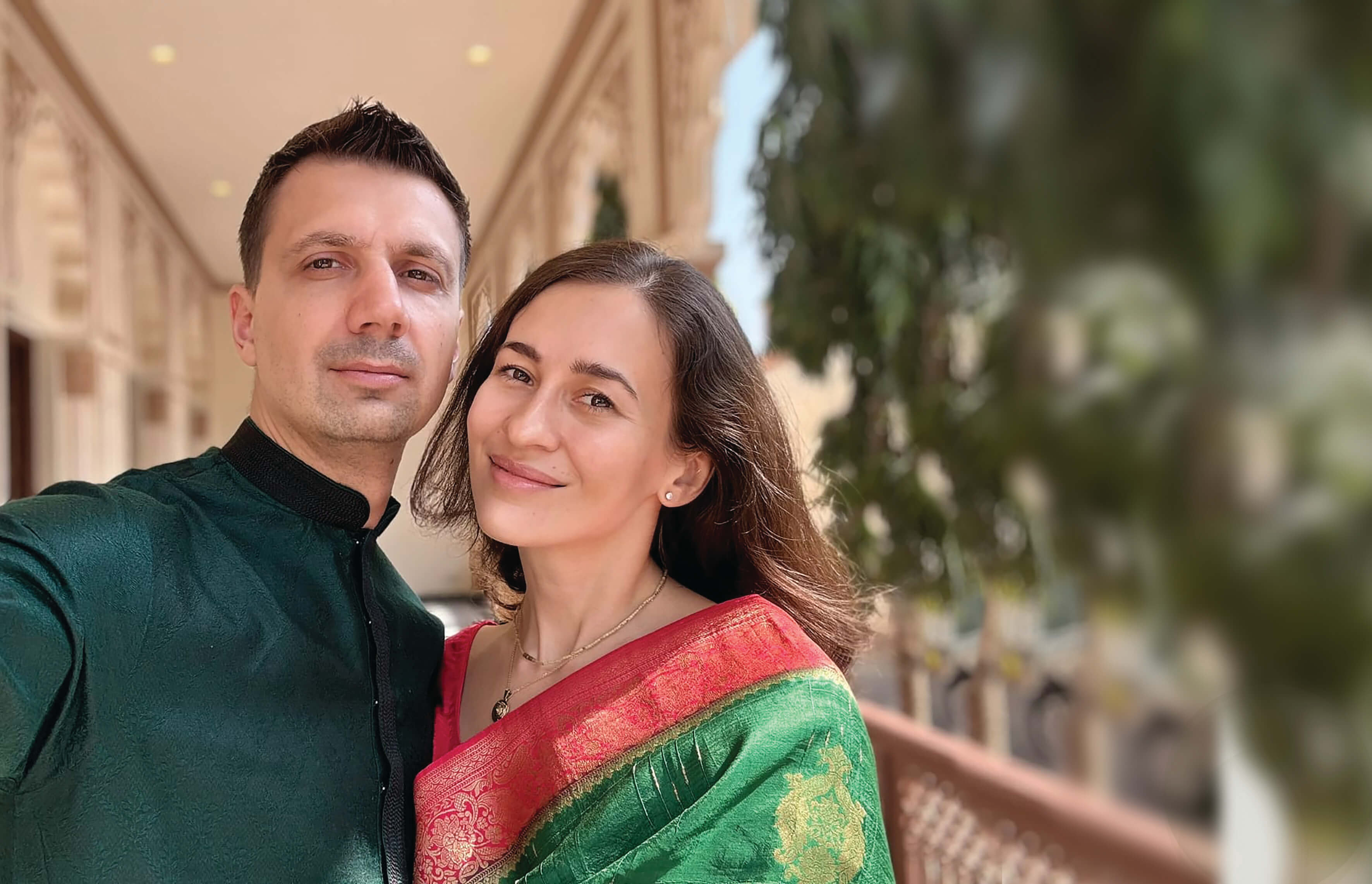
The Story of a Family That Found God in India
Today, we would like to introduce you to an extraordinary family whose story is an example of how personal paths, running parallel for decades, can converge at one point, thanks to India, the ancient spiritual tradition of Sanatana Dharma, and the grace of a Satguru. Oksana and Konstantin Gorchakov met in India, a country that brought them together not only through business but also through a deep connection that each of them developed after going through their own journeys of search and personal crises. Living between Russia and India, and raising their daughter within the Indian spiritual tradition, they share their story.
Oksana’s Story
From a Small Town to Life in Moscow
Being from a small town in the south of the Chelyabinsk region, I felt an interest in mysticism, philosophy, and religion from an early age. However, my career path for more than 10 years was in the banking sector, where I grew from a regional marketing specialist to the head of social and entrepreneurial programs at a large federal bank in Moscow.
The Other Side of a Successful Career
It was the kind of job one could only dream of: I led a department that created programs to support small businesses. I regularly interacted with dozens of entrepreneurs across different regions of Russia, which was truly inspiring. However, it wasn’t always easy — being part of a large corporate system meant dealing with various challenges.
I quickly realized that simply being professional and doing your job well, even exceeding expectations, is not enough. There will always be people and circumstances you depend on but cannot control. Realizing that the only thing I could truly influence was myself, I began searching for ways to manage and transform my mind. I attended psychological training sessions and started long-distance running, which felt similar to meditation. After completing three marathons (42.1 km) in different countries, I understood how much it depends on our mind — not only whether we reach the finish line, but also what the journey feels like. Now I know that even Arjuna in the Bhagavad Gita “complained” to Lord Krishna that controlling the mind is more difficult than controlling the wind. Spiritual practice can help with this—but at that time, spirituality still felt distant.
Moving to London and Discovering Ancient Indian Spiritual Practices
The year 2017 became the peak of my corporate career: a charity run I created within the bank grew into an event with thousands of participants across ten cities in Russia and three countries. I won a prestigious scholarship and moved to London to study public administration, while continuing to work remotely in Russia. But in 2018, everything suddenly changed: the bank where I worked was nationalized, and I had to resign. Finding a job in London on a student visa as a Russian citizen was nearly impossible. I felt lost.
That was when I first met a disciple of my future Teacher. She spoke about some Guru and about the practice of Atma Kriya Yoga* — and all of it sounded strange and even suspicious to my mind at the time, as I was deeply absorbed in my own problems. Like Arjuna, I stood on my own Kurukshetra, not understanding what I should do with my life and wanting to escape from everything. Yet it was during this period that I first attended Om Chanting** — for forty-five minutes, we chanted “Om” in Green Park. It felt unusual, and at the same time, surprisingly good.
First Trip to India and a New Phase in My Career
In the end, I couldn’t stay in London. It was a painful experience, and I began to face health issues. Because of this difficult moment, I found myself — almost without realizing how — in India, at a Vipassana retreat in a village near Mumbai. They say you cannot come to India unless the country calls you. That is exactly what happened to me: I went there almost to save myself, driven not by reason, but by an instinctive feeling that “I need to be there.” Those ten days of silence and meditation transformed my life: they healed me, brought me back to myself, and opened the door to a deep relationship with India — a country I would return to many times to restore myself and feel that sense of inner freedom again.
After returning to Russia, I resumed work, this time in a state-owned bank, working on a large social project. Over the next three years, I developed a national entrepreneurship training program for the wives of military personnel. The task was ambitious and inspiring, but it became increasingly difficult: within the corporate environment, I felt like I couldn’t breathe. Despite good results, recognition of the importance of my work, and career growth, I felt an increasing emptiness inside. Only during my trips to India did I feel a deep inner happiness and a sense that I had returned home.
The Year Everything Changed: Meeting the Teacher
Gradually, a desire grew within me to consciously step onto a spiritual path. I realized it was becoming more important for me to give space to God in my life. I was drawn to the tradition of Sanatana Dharma, while at the same time I explored Orthodoxy and visited monasteries, trying to understand where my true path lay.
The summer of 2021 became especially significant. While on vacation in St. Petersburg, I came across the Bhagavad Gita in a simple translation by Boris Grebenshchikov in a bookstore. This text deeply moved me — it answered all the questions I had carried within me for so long. I bought several copies and gave them to friends, but no one seemed to understand my excitement. It turned out that everyone around me already knew about the “Gita” — except me. From that moment, it felt as if someone had pressed a “restart” button in my life.
A few days later, my friends “by chance” invited me to a concert by Sati Kazanova, where for the first time an online darshan of my future Teacher — Paramahamsa Vishwananda — was taking place. The moment I saw His face, I felt that unmistakable sensation: I was home. Tears flowed uncontrollably. But soon, everyday life dimmed that experience, and the mind once again forgot.
Meanwhile, at work — which had always been central to my life — things were becoming increasingly difficult without any clear reason. Now I understand: this is what happens when life is driven only by the mind, without a steady spiritual practice. At the same time, knowledge about the tradition of Sanatana Dharma and the importance of a Teacher began to come into my life. I read Autobiography of a Yogi and discovered Two Lives by Concordia Antarova, a follower of the Roerichs, who were deeply connected with India. Continuing my search for ways to “fix” my inner state, I attended a past-life regression session with a well-known practitioner and founder of an institute of regression therapy. During the session, while under hypnosis, I asked: “Do I have a Teacher?” I was shown the image of Gurudev, and a clear message followed: “Go to Him.”
The preparation for meeting the Teacher seemed to unfold effortlessly. Circumstances aligned: around the same time, I received initiation into the spiritual practice that Gurudev had given to the world — the very same Atma Kriya Yoga I had first heard about back in London in 2018. I was initiated by the well-known singer and disciple of Gurudev, Sati Kazanova, who performs mantras in Sanskrit. This event, along with the practice itself, began to transform my consciousness and inner state. Soon after, I felt a natural inclination to become a vegetarian — and I have remained so ever since.
At the end of the year, I decided to travel for a personal meeting with the Teacher at His ashram in Germany, and once again Gurudev demonstrated the power of His grace. It was another wave of COVID, and strict quarantine rules were in place across Europe. I did not have a vaccination certificate approved by the EU, and upon arrival in Frankfurt, I was detained with the threat of visa cancellation and deportation. However, after the police officers saw a photo of the Teacher, I was released. At our first meeting, simply being in the presence of the Teacher, I felt that having found God in my life, I no longer had anything to worry about. As Krishna says in the Bhagavad Gita, the Lord personally takes responsibility for the well-being and prosperity of those who worship Him with love (9.22).
Moving to India and Discipleship
The remarkable year of 2021 ended with a trip to Varanasi — a city where, it is said, Shiva destroys everything that prevents the soul from moving toward God. This is exactly what happened in my life: by February 2022, circumstances unfolded in such a way that I left for India — to my Teacher and to God.
In May 2022, I accepted discipleship under Paramahamsa Vishwananda and remained in Vrindavan, in my Teacher’s ashram. This marked the beginning of a new stage and a conscious spiritual path.
For the first time, I realized how little a person actually does, and how great the presence of the Divine is when one builds a relationship with Him. With the guidance of Gurudev and a senior disciple, Swamini Abhirami, who had lived in Vrindavan for many years, I was responsible for organizing a concert by Sati Kazanova at the Russian Embassy in Delhi and conducted my first pilgrimage across sacred places in India for Russian entrepreneurs. Gurudev blessed me to stay in India and establish a consulting company.
Meeting My Husband and the Birth of Our Daughter as the Guru’s Grace
The entire year of 2022 passed in pilgrimages, meetings, journeys to sacred places, and immersion in the tradition of Sanatana Dharma. Within me grew a desire to discover what I was meant to dedicate my life to — my dharma. Before meeting the Guru, I had lived driven by ambition. Now, my heart longed to understand and begin living what God wanted from me. As it is said in the Bhagavad Gita, it is better to imperfectly follow one’s own dharma than to perfectly follow someone else’s (18.47).
Gurudev blessed the launch of a consulting company in India, and from the moment I accepted discipleship, I tried to do what the Teacher considered best for me. I wasn’t thinking about relationships, but during the company registration process in Delhi, while resolving various challenges, I met my future husband. We “met” in a chat of Russian entrepreneurs in India: I was looking for a second Indian director for my company, and he offered help. We first met in person after my pilgrimage to the sacred places of Tamil Nadu, where I performed a kora around the sacred mountain Arunachala and visited a temple where Shiva is worshipped in the form of Nataraja. To my amazement, when I met this Russian entrepreneur in Gurgaon, I saw that the wallpaper on his phone was an image of Shiva. My future husband turned out to be not only a businessman, but also a vegetarian Vaishnava. Our relationship began almost immediately.
Later, Lord Shiva manifested in our lives many more times — during pilgrimages to Varanasi, while circumambulating the sacred Mount Kailash, and at the birth of our daughter. She was born on the day of Akshaya Tritiya and falls asleep to the Tryambakam mantra.
In the tradition of Sanatana Dharma, it is said that the Satguru is even more significant than God in a person’s life, because without His grace, it is impossible to know God. My life is a living proof of this. The grace of my Gurudev, Paramahamsa Vishwananda, made the impossible possible. Without Him, I would never have dared to leave my position at the bank, pack my belongings, and move to India. What some considered madness became an act of trust in my Teacher — and led me to find not only God, but also my husband and daughter.
Konstantin’s Path: The Search for Meaning
From an early age, I was interested in the structure of the world and the patterns that go beyond material science. There was a feeling that a higher knowledge exists — one that cannot be reduced to formulas and theoretical constructs. However, after graduating from university, my focus shifted toward entrepreneurship. I built my own business and concentrated on material success, studying books, lectures, and modern techniques of management and personal effectiveness. Despite the wide range of knowledge I gained, I could not find a stable system that truly led to both inner and outer fulfillment. By the age of thirty, I came to understand that material methods cannot explain the fundamental principles of life — the answers must be sought in the spiritual realm.
During this period, I studied Orthodoxy as well as Western and Eastern philosophical schools, but none of them provided a complete picture. At the age of thirty, I almost accidentally found myself in a pilgrimage group traveling to India. At that time, I knew almost nothing about Hinduism, but the prospect of visiting the Himalayas and ancient temples genuinely intrigued me.
Discovering Hinduism
Over the course of a month, we visited Rishikesh, Badrinath, and Vrindavan. With each passing day, a growing realization emerged: behind the outward complexity and unfamiliarity of the tradition lay a coherent and profound system of spiritual knowledge. Upon returning to Russia, I began studying the Bhagavad Gita and Shrimad Bhagavatam, joined the Moscow branch of ISKCON, and immersed myself in the practices of japa meditation and sankirtan. Together with like-minded people, we organized monthly harinamas in Moscow and published several editions of the magazine Insight, featuring transcripts of lectures by spiritual and public leaders promoting spiritual knowledge and traditions. Over several years, we also organized pilgrimage trips to India.
International Business and Spirituality
A few years after beginning my spiritual practice, my partners and I launched a business in Africa. In Uganda, we opened a factory producing fiberglass reinforcement (GFRP rebars), and it was there that I met representatives of the Swaminarayan school. This strengthened my understanding that my connection to Vaishnavism was not accidental: wherever I went, the philosophy of Sanatana Dharma manifested through people and circumstances.
Two years after launching the enterprise in Uganda, my partners from Gujarat invited me to open a similar factory in Rajkot. That is how I returned to India — this time with business interests. In total, India became my home for nearly four years.
During the 2020 pandemic, I traveled to India for three months to assist with launching production, but due to border closures, I remained there for almost a year. During that time, I contributed to adapting international standards for GFRP rebars in BIS and NHAI, delivered a lecture at the Civil Engineering faculty at the Maharaja Sayajirao University of Baroda, and met with Nitin Gadkari, the minister of transport in India, presenting an innovative material later implemented in NHAI infrastructure projects.
After returning to Russia, I headed a project portfolio management office in a construction company and worked on a major infrastructure project related to gas field development in Urengoy. Later, together with partners, we founded a private investment fund focused on waste management and environmental technologies.
Return to India and Meeting My Future Wife
In 2022, I returned to India again — this time for three years. During this period, we established two companies focused on waste management technologies and launched a new GFRP rebar plant in Haryana. I actively cooperated with the municipalities of Delhi, Mumbai, Hyderabad, and Gurgaon, concluded a cooperation agreement with JBM Enviro, and, in the direction of GFRP, we became technological partners of the Jindal group, signing agreements with my friends Sahil and Pratik Jindal.
During this business trip, I met my future wife. Together, we founded the consulting company BS Consulting, whose primary goal is to help Russian businesses establish partnerships with Indian counterparts. The company runs a private Telegram channel where it publishes analytical materials on India’s economy and culture, and has produced around 50 research reports across various industries. In collaboration with Indria Consulting, which my wife had founded earlier, we organized two business missions for Russian entrepreneurs and the private investment fund Dome Foundation. During these trips, participants visited Vrindavan and Varanasi, познакомились с культурой Sanatana Dharma and the specifics of doing business in India. Our materials have been published by RBC and the Higher School of Economics in Russia. My wife and I are also speakers at panel discussions at the Moscow School of Management SKOLKOVO and SberUniversity on the topic of doing business and building connections with India.
The Birth of Agathia Devotional Arts
In 2024, a significant event for our family took place — a pilgrimage around the sacred Mount Kailash. This experience symbolically concluded a long journey and defined our future direction: integrating professional, cultural, and spiritual missions.
Even before the pandemic, friends had asked me to create a murti of Lakshmi-Nrisimha for a home altar. The project was challenging but successful. Three years later, my wife, inspired by an image of Nrisimha, suggested creating a murti of Goddess Durga. Although initially postponed due to production limitations in India, the idea was revived in 2025 after the birth of our daughter, Agatha. This led to the creation of the brand Agathia Devotional Arts, specializing in high-quality bronze murtis and ritual items for home altars.
At present, the work on the murti of Goddess Durga has been completed. Goddess Lakshmi, Lord Shiva, and Radha-Krishna are currently in preparation for release. We perform daily puja at our home altar, and initially the project had no commercial purpose — we were simply striving for a level of beauty and quality for our own altar that we could not find in available products. However, interest from friends and devotees revealed the potential of this direction. In the near future, we plan to release a small series of murtis for distribution among followers of Sanatana Dharma and collectors in Russia, India, and other countries.
Family as Service to the World
According to Konstantin and Oksana, raising their daughter in alignment with spiritual values, they see their family’s mission as serving their Teacher through pilgrimages and business tours that strengthen cultural and economic ties between Russia and India.
Having accepted discipleship under a Vaishnava acharya and Satguru, Oksana received qualification as a teacher of sacred texts and Indian philosophy from Bhakti Marga Academy and teaches the Bhagavad Gita to those seeking happiness or a deeper understanding of India.
“My Teacher speaks about the beauty of Sanatana Dharma — a path that offers knowledge of the Divine and practices for working with consciousness, needed by everyone in the modern world, regardless of religion, nationality, or lifestyle,” Oksana shares.