Achala Moulik’s Speech at MGIMO on the Eve of the Leo Tolstoy International Peace Prize Ceremony
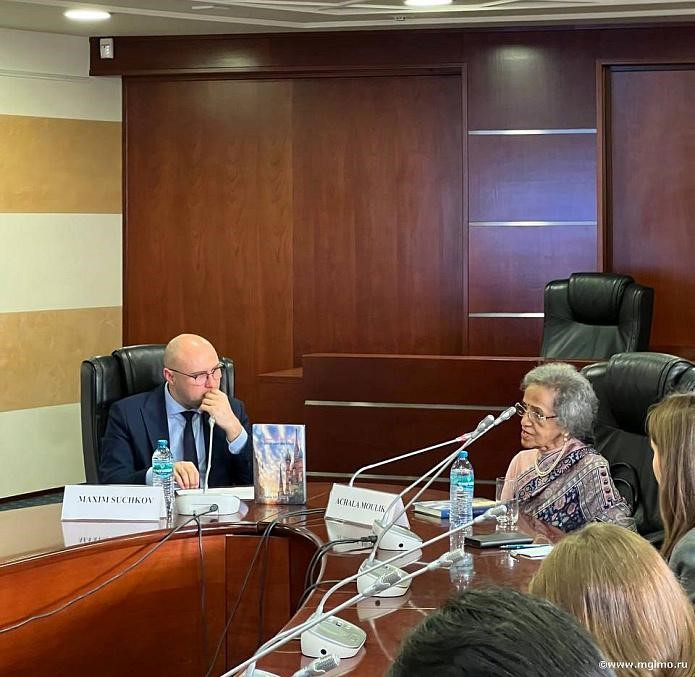
On September 8, 2025, the renowned Indian writer Achala Moulik addressed the students of MGIMO. She arrived in Moscow as a jury member for the Leo Tolstoy International Peace Prize, the results of which were announced in Moscow on the eve of the great Russian writer's birthday.
The meeting between A. Moulik and the future specialists in international relations was moderated by M.A. Suchkov, Director of the MGIMO Institute for International Studies (IIS). The event was organized with the support of the IIS Center for Scientific Diplomacy and Youth in Science.
The opening part of the expert’s speech focused on the historical and modern development of the Russian-Indian partnership. A. Moulik highlighted that for several centuries, relations between Russia and India have grown in a spirit of mutual respect, supporting each other and allowing societies and civilizations to influence one another. According to the Indian specialist, as a multipolar world order takes shape, major powers outside the Western sphere should expand not only political and diplomatic ties but also cultural and humanitarian connections.
Continuing the meeting, Achala Moulik shared her experience working in India’s government structures, noting what allowed her to combine the roles of politician and writer throughout her career and life. She also presented several of her works, including her latest published book. Thanks to A. Moulik’s extensive translation work, many classic works of Russian literature have become known to a wide Indian audience.
The writer also spoke about how she developed an interest in Russian literature and why the works of Russian and world classics, such as A.S. Pushkin, L.N. Tolstoy, F.M. Dostoevsky, and M.A. Bulgakov, evoke genuine interest among Indian readers. Additionally, she recommended Indian authors whose works offer a deeper insight into Indian culture and society.
In the final part of the conversation, A. Moulik answered questions from the audience regarding the role of literature in shaping a positive image of a country in the world, the characteristics of the Indian mentality and culture, and the influence of Indian political thinkers on the development of international relations theory and political science.
The engaging discussion with the distinguished Indian writer and scholar provided activists, young Indologists, and future diplomats with an excellent opportunity to hear firsthand about the nuances of the interaction between culture and politics, and the importance of humanitarian cooperation in the development of the Russian-Indian strategic partnership.