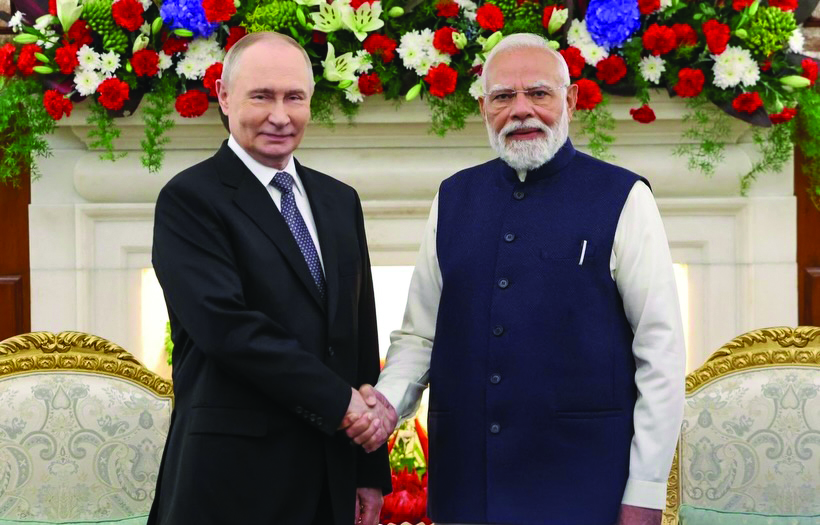
23rd Russian-Indian Forum: Agreements and a Focus on Friendship
On December 4–5, the 23rd Russian-Indian Summit took place in New Delhi. It was remembered not only for its formal outcomes and signed agreements, but also for the remarkably warm and heartfelt atmosphere that was felt even by those following the events on their television and mobile screens.
From the very first moments, it was clear that the summit would be special: at the aircraft steps, Russian President Vladimir Putin was personally welcomed by Indian Prime Minister Narendra Modi. Then, in a break from protocol, they travelled together in the Indian leader’s car to an informal dinner at his residence.
A Close Friendship
It is well known that the personal relationship between Putin and Modi is marked by a special warmth. “Our relations with India are developing in many areas, and I am very pleased to have the opportunity to meet Prime Minister Modi, with whom we are connected not only by professional ties but also by personal, friendly relations,” the Russian leader emphasized in an interview with Aaj Tak and India Today ahead of his visit to India.
During the summit, the So Sorry studio of the India Today Group released an animated video in which characters modeled on Modi and Putin ride a motorcycle together, singing a song about friendship. The plot was inspired by the iconic Bollywood film Sholay (released in the Soviet Union as Revenge and the Law), where two close friends, played by Dharmendra and Amitabh Bachchan, overcome all obstacles together and defeat the villain.
The summit demonstrated that, much like in the famous film, Russian-Indian friendship has withstood all challenges. Despite sanctions, uninterrupted supplies of Russian oil to India will continue. Cooperation in nuclear energy is also developing successfully, with Moscow offering New Delhi advanced technologies in the construction of small modular reactors. Additionally, the success of India’s “Operation Sindur” in May 2025 was supported by the S-400 air defense missile systems supplied by Russia.
Symbolism of the Visit
India is a country where any event can acquire a deeper religious meaning. The visit of the Russian president also gained such symbolic significance.
In Varanasi, residents performed an aarti ritual in front of a portrait of Putin. Aarti is a Hindu ritual of worship using lit lamps, usually performed before a murti — a statue or image of a deity. It can also be conducted to welcome a guest or before a photograph of a respected person as a mark of special reverence.
Prime Minister Modi also presented Putin with a Russian-language edition of the Bhagavad Gita. The Bhagavad Gita is part of the ancient Indian epic Mahabharata and one of the most important philosophical texts in Hinduism.
Focus on the Economy
During the visit, the main focus was on developing and diversifying bilateral economic ties. Trade turnover reached approximately $65 billion, though the growth was largely driven by exports from Russia. To address this imbalance, Russian businesses are ready to increase imports of goods and services from India.
As part of the summit, a business forum was held, attended by leaders of key Russian ministries and agencies, as well as representatives of the business community directly engaged with India. The leaders of both countries took part in the plenary session.
“The Russian delegation has come not only to discuss energy issues, not only to place orders and sign contracts for oil or gas supplies — we want to develop multifaceted relations with India across various areas,” Putin emphasized. Modi, in turn, outlined five priority sectors for strengthening cooperation: logistics, the maritime sector, automobile manufacturing, pharmaceuticals, and the textile industry.
Among the key outcomes of the summit was a program for developing strategic areas of Russian-Indian economic cooperation, aimed at achieving a trade turnover of $100 billion by 2030. A commercial agreement was also signed to build a large Russian-Indian pharmaceutical plant in the Kaluga region, focused on producing anti-cancer medicines using advanced Indian technologies.
In addition, an intergovernmental agreement was signed on the temporary employment of citizens of one country in the territory of the other, guaranteeing the rights of Indian labor migrants in Russia. The number of Indian workers continues to grow: by the end of 2025, around 40,000 Indians had received work permits in the country.
There was also good news for Russian tourists planning a trip to India — the consular fee for issuing electronic tourist visas for stays of up to 30 days has been abolished. Plans are underway to introduce a mutual visa-free regime for group tourist travel. Furthermore, both sides are working on simplifying visa procedures for entrepreneurs and business representatives.
Hearing the Voice of Russia in India
Another major event during the summit was the launch of the RT India television channel. It is no secret that coverage of the Russian agenda in Indian media is often influenced by Western narratives. The new RT channel aims to help address this.
The launch was preceded by a large-scale advertising campaign: billboards featuring Vladimir Putin and Narendra Modi appeared in major Indian cities, and a branded “Museum of Russia and India” train began running in the Delhi Metro, showcasing the history of relations between the two countries.
At the official launch ceremony, a moving video was presented, reminding viewers that the strong foundation of today’s friendship between Moscow and New Delhi was laid decades ago, during the Soviet era. Using artificial intelligence, historical figures such as Jawaharlal Nehru, Nikita Khrushchev, Yuri Gagarin, Rakesh Sharma, Leonid Brezhnev, and Indira Gandhi were “brought to life,” with their statements about Soviet-Indian relations voiced once again.
“Our peoples are like brothers in spirit and in all their aspirations,” said Nikita Khrushchev.
“India from above is very beautiful. But on the ground, it is even more beautiful. It is dear because true friends live here,” said the first cosmonaut, Yuri Gagarin.
“Cooperation between India and the Soviet Union has benefited millions and harmed no one,” — in these words of Indira Gandhi lies, perhaps, the secret of the enduring strength of relations between the two countries.